🌑

SICPJS 第一章:用函数构建抽象

Read in English

词汇表

  • 计算过程(computational process,巫师脑中的精灵):一种思想,看不见也摸不到,但能解决问题并驱动现实世界。
  • 程序(program,巫师的咒语):通过编程语言规定计算过程,操纵另一种抽象事物——数据。
  • 程序员(programmer,巫师的学徒):构思想法并施展咒语的人。
  • 数据(data):
  • JavaScript:我们的咒语格式,它从 Scheme 继承了核心特性:一等函数和动态类型。

问题

  • 如何让你的咒语精确完成你想要的事情?
    • 如何提前预见系统的运行方式(测试?)
    • 如何确保在出现意外问题时不会导致灾难性后果(容错?)
    • 当问题出现时如何调试(监控?)

笔记

  • 让你的咒语精确完成你想要的事情
  • 良好设计的程序以模块化方式构建,使各部分可以独立构建、替换和调试(人类的局限所在:化繁为简!复杂的想法由多个简单想法组成,所以只需将其分解。)

1.1 编程的基本要素

词汇表

  • 原始表达式(primitive expressions):语言所涉及的最简单实体。
  • 组合手段(means of combination):由更简单的元素构建复合元素的方式。
  • 抽象手段(means of abstraction):将复合元素命名并作为单元进行操作的方式。
  • 数据(data):我们想要操作的”材料”。
  • 函数(function):描述操作数据规则的东西。

问题

笔记

  • 强大的语言作为框架来组织我们对过程的想法。(关注语言提供了哪些组合简单想法的手段。面向对象编程?不仅仅是语言,像 React 这样的框架也提供了精心设计的抽象(虚拟 DOM),以及一种便于组织模块化前端组件的方式。)

1.1.1 表达式

词汇表

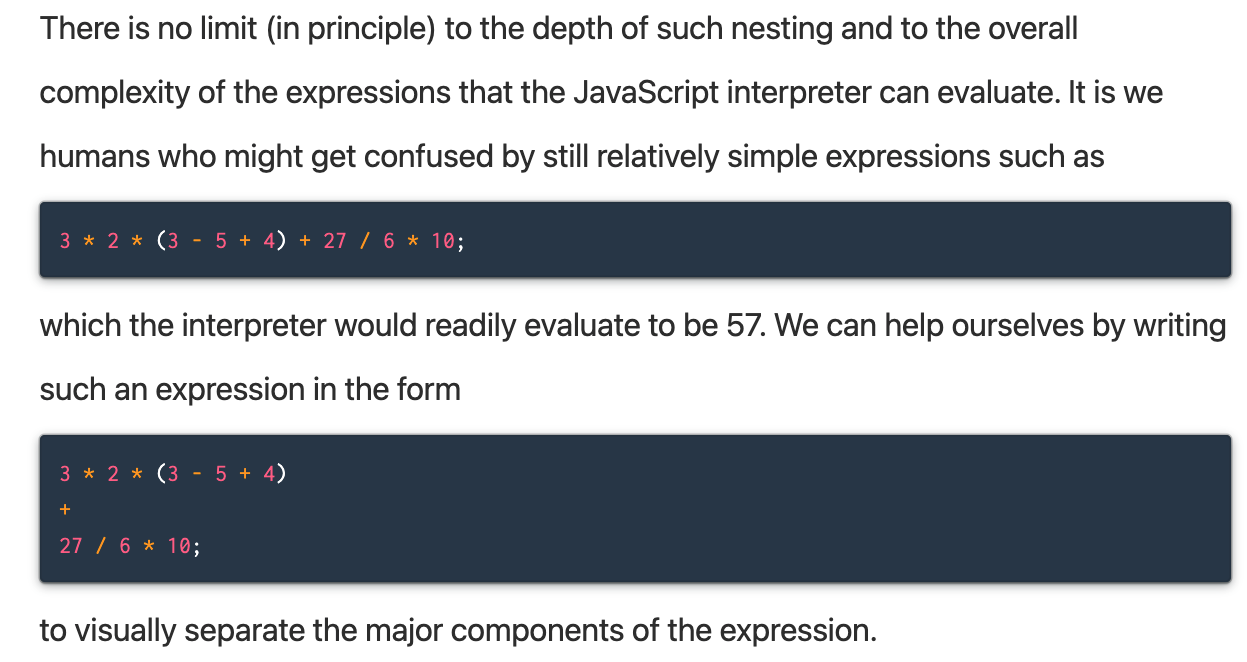
  • 表达式(expression):由一个_表达式_后跟一个分号组成。(在我看来,一行基本上就是一个表达式。)
    • 原始表达式:
      • 数字
    • 组合表达式:
      • 由其他表达式组合而成的表达式(运算符组合)

问题

笔记

  • expression

1.1.2 命名与环境

词汇表

  • 命名(naming):提供名称-值的存储,是最简单的抽象手段,提供了一种复用复杂值(组合表达式)的简便方式。
  • 环境(environment):命名的代价(创建一个值并通过引用其名称来复用它)是我们必须维护一种内存来保存键值对,这就是环境。

问题

笔记

1.1.3 求值运算符组合

词汇表

问题

笔记

  • 我们不会一直对组合表达式求值,有时只对原始表达式(如数据或名称)求值。
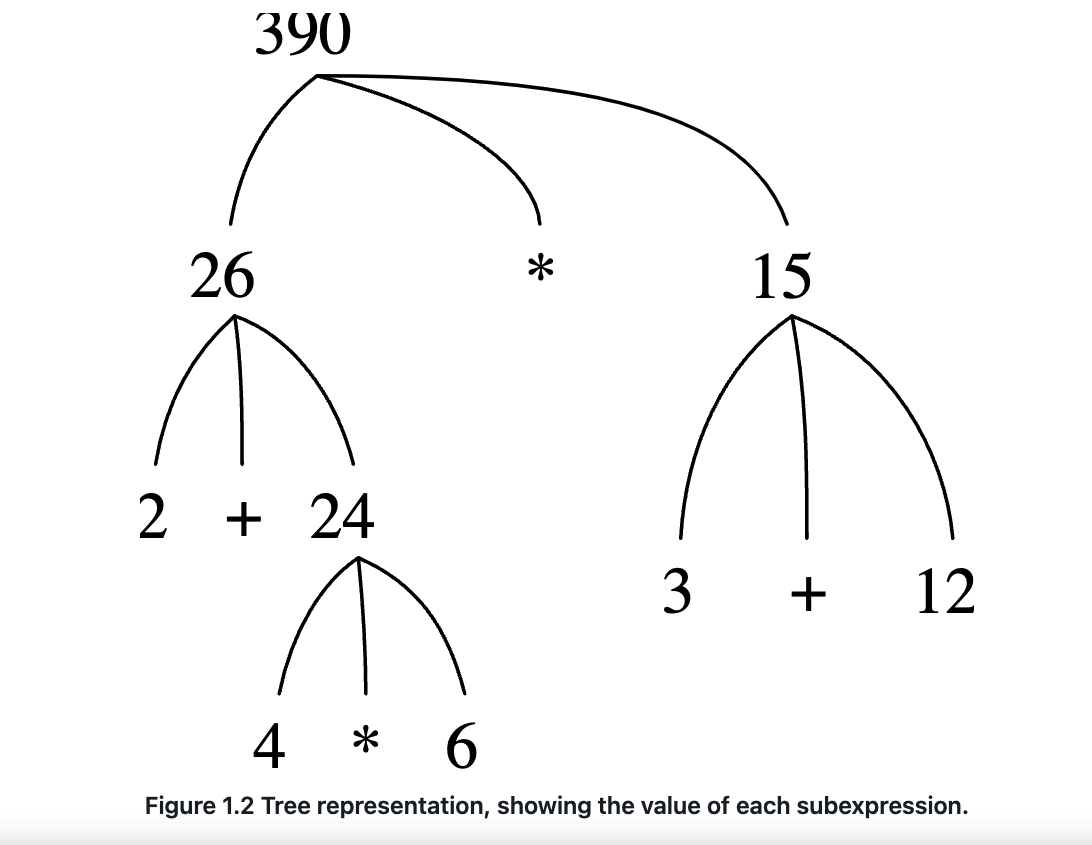
  • 求值运算符组合本质上是一个递归过程,如下所示:
  • combineexpression combineexpressiontree

1.1.4 复合函数

词汇表

  • 复合函数(compound functions):本质上是一种组合手段(将多个表达式组合在一起)和抽象手段(作为一个单元,通常代表一种操作)——与命名数据相比,它抽象的是操作。

问题

笔记
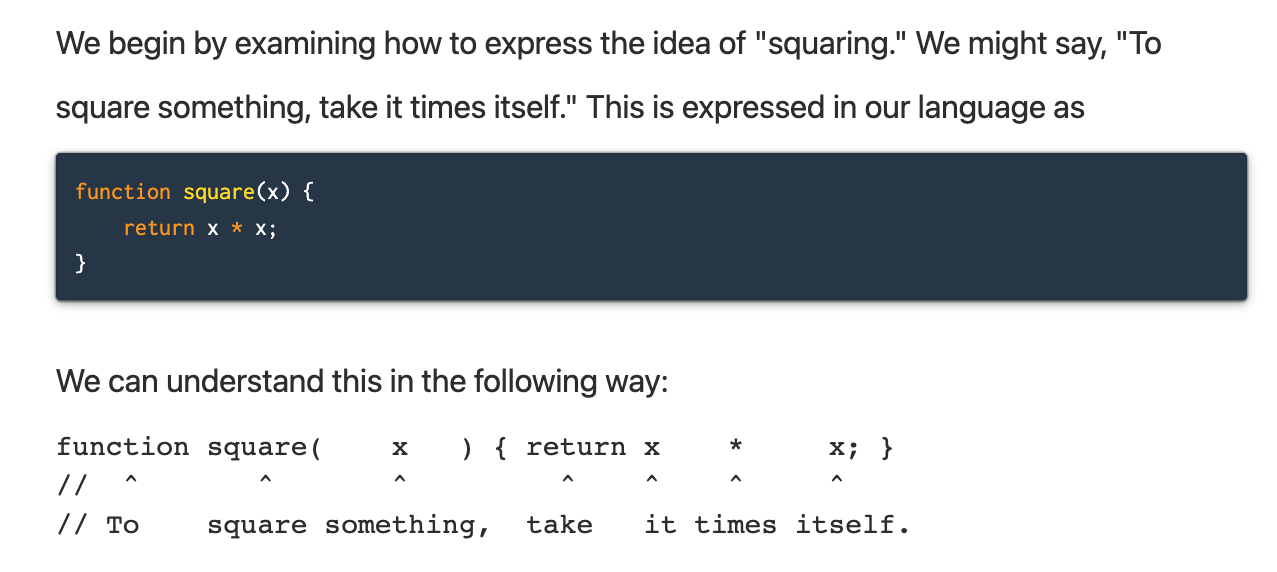
  • function

1.1.5 函数应用的代换模型

词汇表

  • 代换模型(substitution model):对复合函数应用于参数求值,即将函数返回表达式中的每个形参替换为对应的实参。
  • 正则序求值(normal-order evaluation):完全展开后再归约。JavaScript 出于效率考虑使用代换模型,但正则序求值可以是一种非常有价值的工具。

问题

笔记

1.1.6 条件表达式与谓词

词汇表

  • 谓词(predicate):返回 true 或 false 的表达式。
  • expression__1 && expression__2:expression__1 ? expression__2 : false
  • expression__1 || expression__2:expression__1 ? true : expression__2
  • !expression:expression__1 ? false : true

问题

笔记

  • predicate
  • 注意,&&|| 是语法形式,而非运算符;它们右边的表达式并不总是会被求值。

1.1.7 示例:牛顿法求平方根

词汇表

问题

笔记

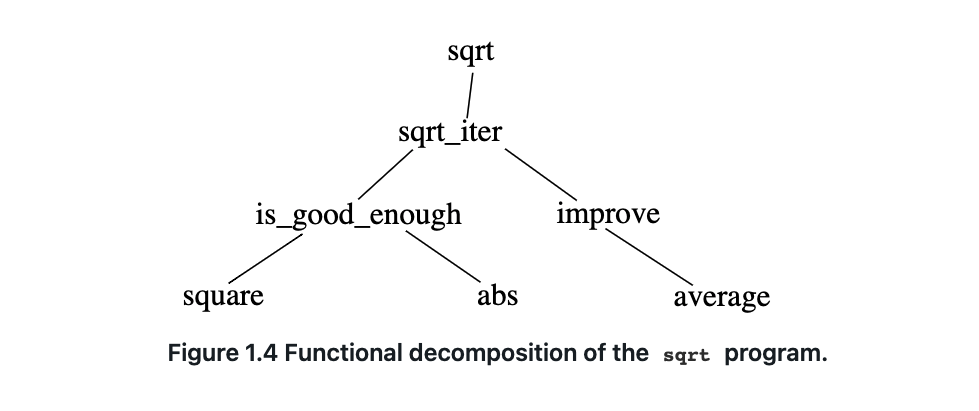
  • 将一个大程序拆分为若干小块,并分别构建。

  • 通过函数调用,无需任何循环语法就可以构建迭代结构。

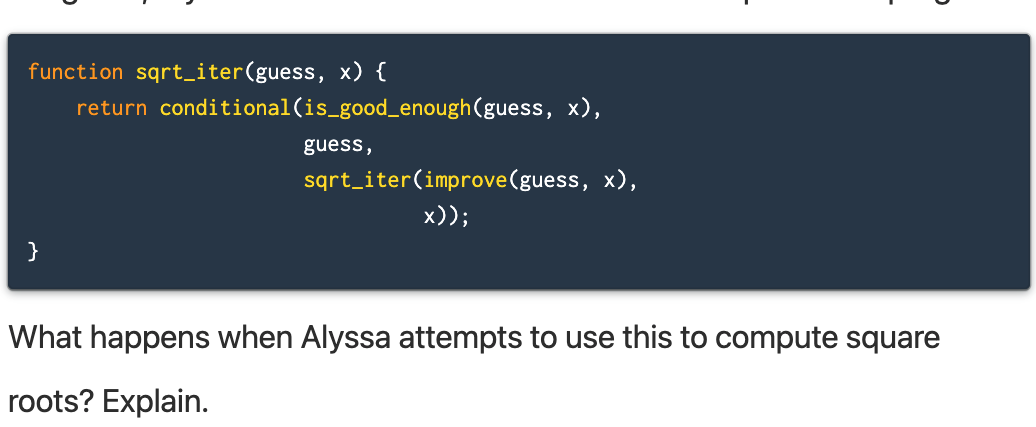
  • sqrtiter 参见应用序求值 applicativeorder
  • 关键在于每个函数都要完成一项可识别的任务,并且能够作为模块在定义其他函数时加以使用。(如何完成最大的任务?将其分解成小块;如何完成这些小块?…)

1.1.8 作为黑盒抽象的函数

词汇表

  • 黑盒(black box):不关心如何做,只关心是什么。所以一个函数应该能够隐藏细节(尽可能隐藏不必要的细节)。
  • 局部名称(local name):函数参数名无关紧要,由函数作者使用,绝不能影响调用者。
  • 块结构(block structure):作为模块,我们在块结构 {} 内声明所有变量和函数,使边界更加清晰(_词法作用域_,封装)。

问题

笔记

  • 阅读源代码时,先将其视为黑盒,只关心它做了什么(函数名),这能省去很多麻烦。
  • 我们将广泛使用块结构来帮助我们将大型程序分解为可处理的小块。

1.2 函数与它们生成的过程

词汇表

问题

  • 如何抽象函数?(如何拆分任务?)
  • 如何预测一个行动的后果?

笔记

  • 可视化后果。
  • 函数是计算过程_局部演化_的模式。它规定了过程的每个阶段如何建立在前一个阶段之上。

1.2.1 线性递归与迭代

词汇表

  • 线性递归(shape):一条延迟操作的链,解释器跟踪稍后要执行的操作。链的长度为 n。时间复杂度 O(n),空间复杂度 O(n)。
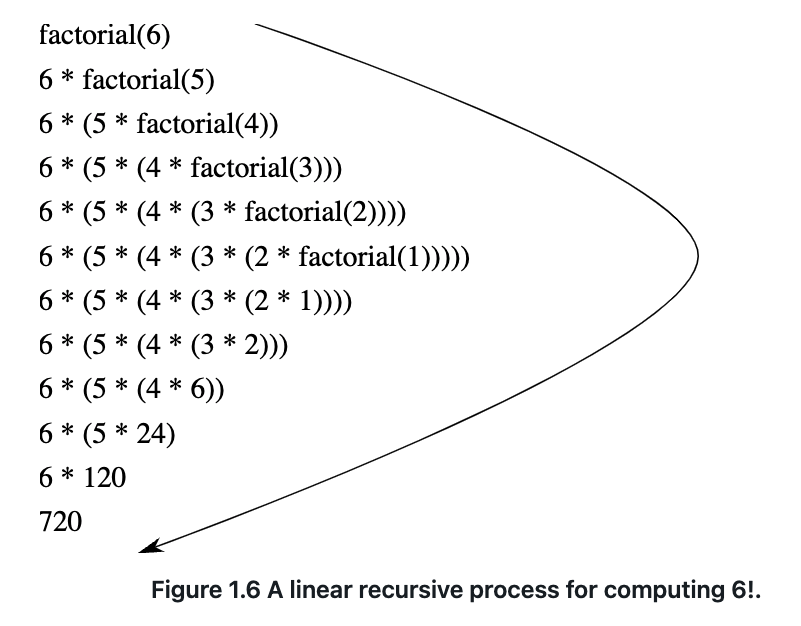
    linearrecursiveprocess
  • 线性迭代(linear iterative):无需增长和收缩。状态可以由固定数量的_状态变量_概括,以及描述状态如何从一个状态更新到另一个状态的固定规则,以及一个(可选的)指定终止条件的结束测试。时间复杂度 O(n),空间复杂度 O(1)。
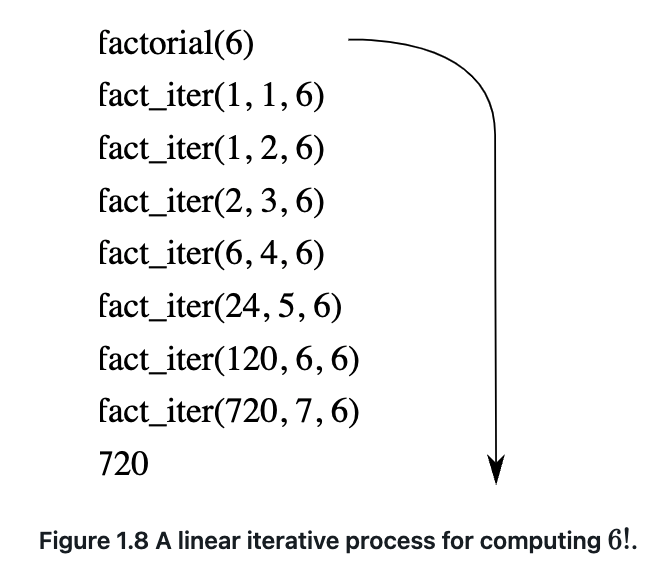
    lineariterativeprocess
  • 区别:迭代过程不需要解释器存储某些”隐藏”状态,所有描述都由状态变量提供。而递归过程借助解释器存储状态,链越长,解释器需要维护的状态就越多。

  • 递归函数(recursive function):指在语法上引用自身的函数,与递归过程无关。递归函数也可以是迭代过程。

  • 递归过程(recursive process):函数的一种演化方式,将状态留给解释器,并调用下一个函数。

  • 尾递归(tail-recursive):常见语言即使在迭代过程的递归函数中也会消耗空间。但 JavaScript 具有尾递归优化,消耗常数空间。借助尾递归实现,迭代可以使用普通的函数调用机制来表达,特殊的迭代构造只作为语法糖存在。

问题

笔记

  • 为什么递归会展开?我认为这是因为我们从上往下看问题,所以需要一直存储”如何解决最顶层问题”,而如果你从下往上看问题,则只需更新状态,无需关心底层问题的解法(我们的目标始终是最顶层的问题)。

1.2.2 树形递归

词汇表

问题

笔记

  • 函数调用自身两次会形成一棵二叉树。我们可以用树状图来分析时间复杂度。(本质上是关于如何在其他函数之上演化函数。)
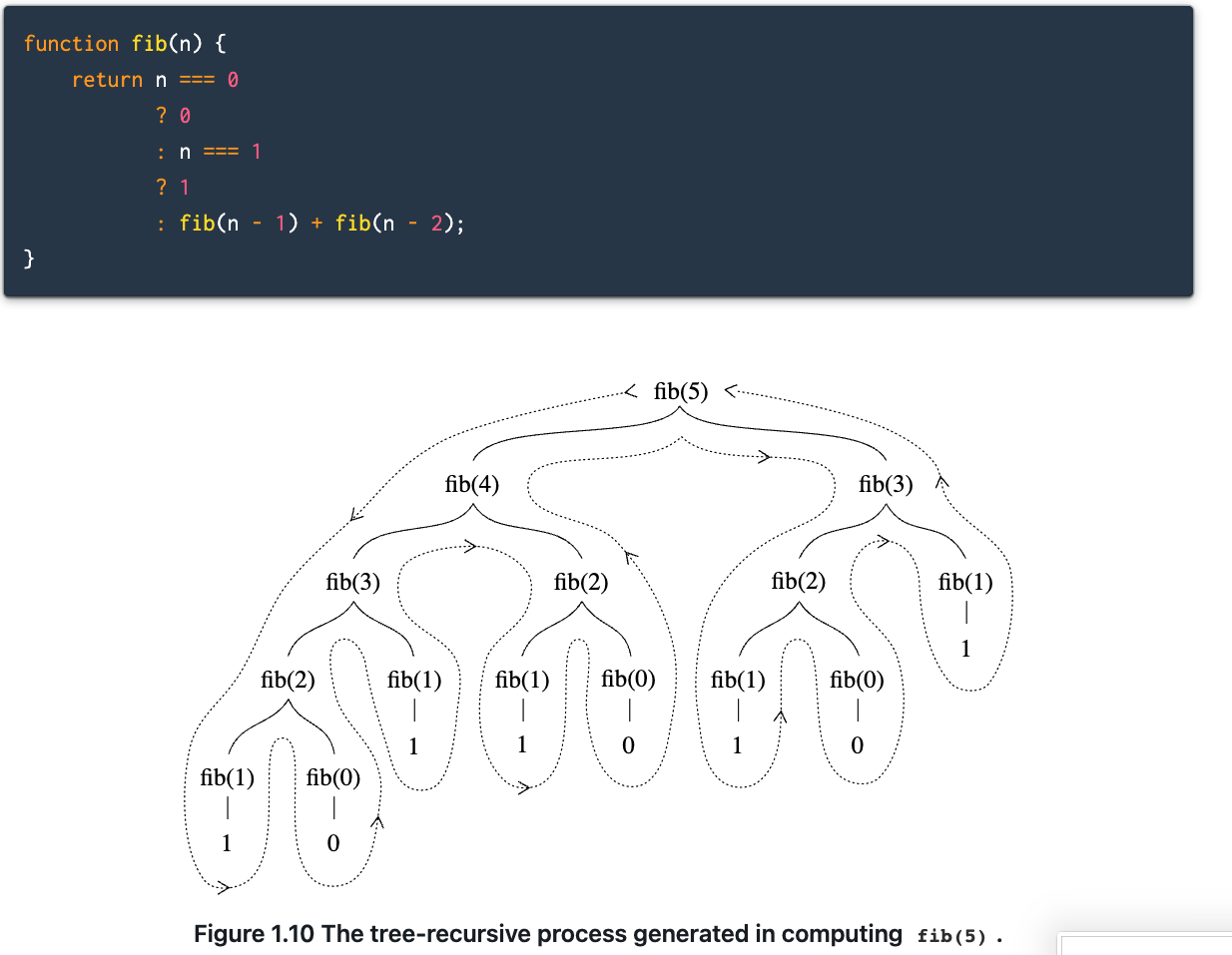
    treerecursiveprocess
  • 树形递归对于树状结构数据或图来说非常有用,且比迭代过程更直观。

  • 改为迭代过程:从下往上思考,f(n) = f(n-1) + f(n-2),所以 f(n) + f(n-1) = f(n+1),我们需要两个状态来存储 n 和 n-1,以及一个限制条件计数。

1
2
3
4
5
6
7
8
function fib(n){
function fib_iter(a, b, count){
return count === 0
? b
: fib_iter(a + b, a, count - 1);
};
return fib_iter(1, 0, n);
}
  • 找零钱

我们能用多少种不同的方式找开 1 美元(100 美分),已知有半美元、25 美分、10 美分、5 美分和 1 美分(即 50 美分、25 美分、10 美分、5 美分和 1 美分)?

1
2
3
4
5
6
7
8
9
10
11
12
13
14
15
16
17
18
19
20
21
22
23
24
25
26
27
28
29
30
31
32
33
34
35
// problem: given 100 or n, count the ways of splitting it in
// 50, 25, 10, 5, and 1

// method2: dp dp[n,m] = Sum(dp[n][m-1] + dp[n-c[m]][m]) dp[1] = 1
// dp是有序的,是上一个状态推出下一个状态。而给的钱是无序的,需要一个维度来记录彼此的联系
// dp[n,m]与dp[n,m-1]使用c[m]面值的钱与不用的时候的次数 dp[n,m] = dp[n,m-1] + dp[n-c[m]][m]
// dp[n] = Sum(dp[n-c[i]])把c认为是有顺序的,从0~i转移,错误
// dp[n-c[m]][m]假设使用了第m种硬币的人, 因为你使用了这种硬币,所以至少使用了一次,减掉这一次,剩下的
// 无论使用过没有都算,这里有点难理解
0 1 2 3 4 5 6
0 0 0 0 0 0 0 0
1 1 1 1 1 1 1 1
5 1 1 1 1 1 2 2
function count_change(n) {
const c = [1, 5, 10, 25, 50]
const dp = new Array(c.length+1)

for(let i = 0; i < c.length+1; i++) {
dp[i] = new Array(n+1).fill(0)
}
for(let i = 1; i < c.length+1; i++) {
dp[i][0] = 1
}
console.log(dp)
for(let i = 1;i <= c.length; i++) {
for(let j = 1; j <= n;j++) {
dp[i][j] = dp[i - 1][j]
const index = j - c[i-1]
console.log(index)
if(index >= 0) dp[i][j] += dp[i][index]
console.log(i,j,dp[i][j])
}
}
return dp[c.length-1][n]
}
  • 练习 1.11
1
2
3
4
5
6
7
8
9
10
11
12
13
14
15
// recursive
function f(n) {
return n < 3
? n
: f(n - 1) + 2 * f(n - 2) + 3 * f(n - 3)
}
// iterative
function c_f(n) {
function f_iter(f1, f2, f3, count) {
return count === n
? f3
: f_iter(f1 + 2 * f2 + 3 * f3, f1, f2, count + 1)
}
return f_iter(2, 1, 0, 0)
}
  • 练习 1.12
1
2
3
4
5
6
7
8
9
10
11
12
13
14
15
16
17
18
19
20
21
22
23
24
25
26
27
28
29
30
31
// consider p[i][j]
// recursive
function p_recursive(i, j) {
return i === 1
? 1
: j === 1
? 1
: p_recursive(i - 1, j) + p_recursive(i, j - 1)
}

// iterative (dp)
function p(i, j) {
if(i < 1 || j < 1) throw new Error('number invalid')
if(i === 1 || j === 1) return 1
// create i + 1 row * j + 1 col array, init value = 0
const dp = new Array(i + 1).fill().map(item => new Array(j + 1).fill(0))
for(let k = 0; k < i + 1; k++) {
dp[k][1] = 1
}
for(let k = 0; k < j + 1; k++) {
dp[1][k] = 1
}
for(let k = 2; k < i + 1; k++) {
for(let g = 2; g < j + 1; g++) {
dp[k][g] = dp[k - 1][g] + dp[k][g - 1]
}
}
return dp[i][j]
}

// the author's solution use row, index to repesent the item, it's the same as mine

1.2.3 增长阶

词汇表

  • 增长阶(order of growth):描述过程所使用计算机资源的方式,通常指时间和存储空间。
  • n:我们将问题规模描述为 n。
  • R(n):规模为 n 的问题所使用的资源量。

问题

笔记

1.2.4 求幂

词汇表

问题

笔记

  • 练习 1.16
1
2
3
4
5
6
7
8
9
10
11
12
13
14
15
16
17
18
19
20
21
22
23
24
25
26
27
28
29
30
31
32
33
34
35
36
37
38
39
40
41
42
43
44
45
46
47
48
49
50
51
52
53
54
55
56
57
58
59
60
61
62
63
64
// fast expt: given b and n, calculate b^n
// naive: b^n = b * b * ..... * b (n time) or = b * b^n-1
// recursive time o(n) store o(n)
function expt(b, n) {
return n === 1
? b
: b * expt(b, n - 1)
}

// iterative store o(1)
function expt(b, n) {
function expt_iter(a, count) {
return count === n
? a
: expt_iter(a * b, count + 1)
}
return expt_iter(b, 1)
}

// mid: fast_expt: every step is the same, we can take a bigger step,
// b^n = (b^n/2)^2 n is even
// b^n = b * b^n-1 n is odd
// O(log n) store O(log n)
function is_even(n) {
return n % 2 === 0
}
function fast_expt(b, n) {
return n === 1
? b
: is_even(n)
? fast_expt(fast_expt(b, n / 2), 2) // wrong! use fast_expt(b, n / 2) * fast_expt(b, n / 2) instead this will overflow bcz (b, 2)
// still need to call fast_expt to solve
: b * fast_expt(b, n - 1)
}

// iterative
function fast_expt(b, n) {
function fast_expt_iter(a, count) {
return count === n // can use n to 0 method too
? a
: count * 2 <= n
? fast_expt_iter(a * a, count * 2)
: fast_expt_iter(a * b, count + 1)
}
return fast_expt_iter(b, 1)
}

// use bit shift, avoid use / instead use >> will be even more faster
function fast_expt(b, n) {
if(n === 0) return 1
let a = 1
while(n) {
if(n % 2 === 0) {
// b^n = (b^2)^n/2
n = n >> 1
} else {
n = n >> 1
a = a * b
}
b = b * b
}
return a
}
// 5 101

1.2.5 最大公约数

词汇表

  • GCD(最大公约数)

问题

笔记

  • 辗转相除法:个人理解,把 a 和 b 看成 m 份 x 和 n 份 x,其中 x 为 GCD(a, b),因为是最大公约数所以显然可以把 a 和 b 分成 m/n 份。a % b = r,= m * x - r * n * x = g * x,他们的最大公约数仍然是 x。
1
2
3
4
5
6
7
8
9
// GCD(a, b) = GCD(a, r) r = a % b
function gcd(a, b) {
return b === 0
? a
: gcd(b, a % b)
}
// 这个函数本身就是迭代的,从上往下不代表一定就是递归,只是思考的方式而已。更像与dp的区别
// 在其他语言,这个就是递归的,可以用for循环写迭代的。在js,有tail_recursive尾递归,这个就是
// for循环的语法糖 空间O(1)
  • 观察正则序求值和应用序求值所生成的不同过程。

1.2.6 示例:素性检验

词汇表

  • 因子测试(divisors test):测试是否存在因子 1 < d < n。注意:n/d * d = n,所以 n/d 和 d 中必有一个小于 sqrt(n),另一个大于。如果找不到小于 sqrt(n) 的因子,那么显然也不存在大于 sqrt(n) 的因子。
  • 费马小定理(Fermat’s Little Theorem):如果 n 是素数,a 是任意小于 n 的正整数,则 a 的 n 次方与 a 对 n 同余。
  • 概率算法(probabilistic algorithms):可以证明误差概率可以任意缩小的一类测试算法。

问题

笔记

  • 因子测试
1
2
3
4
5
6
7
8
9
10
11
12
13
14
15
16
17
18
19
20
21
22
23
24
25
26
27
28
29
30
31
32
33
34
35
36
37
38
39
function is_prime(n) {
function divisor(a, b) {
return a % b === 0
}
function square(a) {
return a * a
}
function divisor_test(r, n) {
return square(r) > n
? true
: divisor(n, r)
? false
: divisor_test(r + 1, n)
}
return divisor_test(2, n)
}
// Exercise 1.23
// improve: if n can't be divided by 2, then all the even number can divide too
function *divisor_generator() {
let i = 2
yield i
i += 1
while(1) {
yield i
i = i + 2
}
}
/*
divisor.next()
{value: 2, done: false}
divisor.next()
{value: 3, done: false}
divisor.next()
{value: 5, done: false}
divisor.next()
{value: 7, done: false}
divisor.next()
{value: 9, done: false}
*/
  • 费马测试
1
2
3
4
5
6
7
8
9
10
11
12
13
14
15
16
17
18
19
20
21
22
23
24
25
26
27
28
29
30
// if n is prime, then a^n mod n = a mod n, if 0 < a < n. O(time*logn)
function is_prime(n) {
function is_even(a) {
return a % 2 === 0
}
function square(a) {
return a * a
}
function random_int_less_than(a) {
return Math.floor(Math.random() * (a - 1)) + 1
}
function fast_expt_mod(a, n, m) {
return n === 0
? 1
: is_even(n)
? square(fast_expt_mod(a, n / 2, m)) % m // js uses 64bit represent number, take remainder each step for perventing overflow
: (a * fast_expt_mod(a, n - 1, m)) % m
}
function fermat_test(a, n) {
return fast_expt_mod (a, n, n) === a % n
}
function fermat_test_time(a, n, time) {
return time === 0
? true
: fermat_test(a, n)
? fermat_test_time(random_int_less_than(n), n, time - 1)
: false
}
return fermat_test_time(random_int_less_than(n), n, 10)
}
1
2
3
4
5
6
7
8
9
10
11
// for testing the time cost of the function, we make a high order function
// to wrap those function, record the start time and end time
function time_spend_of_fn(fn) {
return function(...args) {
const startTime = new Date()
const res = fn.call(this, ...args)
const endTime = new Date()
console.log(`spend: ${endTime - startTime}`)
return res
}
}

1.3 用高阶函数构建抽象

词汇表

  • 函数(回顾):函数是对某些操作组合的抽象,以便更好地复用。
  • 高阶函数(high-order function):我们需要一种方式将操作抽象为函数,这就是高阶函数——将函数作为参数传入,并将函数作为返回值。

问题

笔记

  • 同一种编程模式往往会在许多不同的函数中使用。

1.3.1 函数作为参数

词汇表

问题

笔记

  • 函数作为参数:找出多个函数的公共模式,将其提取为高阶函数。
  • 求和:

考虑以下三个函数:

1
2
3
4
5
6
7
8
9
10
11
12
13
14
15
16
17
18
19
function sum_integers(a, b) {
return a > b
? 0
: a + sum_integers(a + 1, b);
}
function sum_cubes(a, b) {
return a > b
? 0
: cube(a) + sum_cubes(a + 1, b);
}
function pi_sum(a, b) {
return a > b
? 0
: 1 / (a * (a + 2)) + pi_sum(a + 4, b);
}
// whats common partern they have? whats the difference?
// remember the thought: putting some ideas together, look and solve them once
// function is a combination of some expression, so those functions' parts are
// the same majorily, which the different is after ':' and the next() function

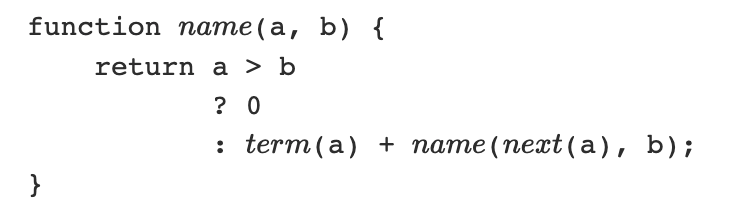
我们可以将大部分相同部分提取为一个新函数,将不同之处留作具体函数 termnext

summatefunction

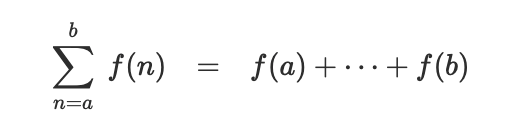
这是数学中的求和:

summatemath
  • 练习 1.29
1
2
3
4
5
6
7
8
9
10
11
12
13
14
15
16
17
18
19
20
21
22
23
24
25
26
27
28
29
30
31
32
33
34
function summate(a, b, f, next) {
return a > b
? 0
: f(a) + summate(next(a), b, f, next)
}
function simpson_integrate(a, b, f, n) {
const h = (b - a) / n
function get_y(k) {
return f(a + k * h)
}
function next(a) {
return a + 1
}
function is_even(a) {
return a % 2 === 0
}
function term(p) {
return p === 0
? get_y(p)
: p === n
? get_y(p)
: is_even(p)
? 2 * get_y(p)
: 4 * get_y(p)
}
return h / 3 * summate(0, n, term, next)
}

// iterative
function summate(a, b, f, next, res) {
return a > b
? res
: summate(next(a), b, f, res + f(a))
}
  • 练习 1.31
1
2
3
4
5
6
7
8
9
10
11
12
13
14
15
16
17
18
19
20
21
22
23
24
25
26
27
28
29
30
31
32
33
34
35
36
37
38
39
40
41
42
function product(a, b, f, next) {
return a > b
? 1
: f(a) * product(next(a), b, f, next)
}
function factorial(n) {
function inc(a) {
return a + 1
}
return product(1, n, a => a, inc)
}
function pi(n) {
function is_even(a) {
return a % 2 === 0
}
let i = 0
function numerator_next(a) {
i += 1
console.log(i)
return is_even(i)
? a
: 2 + a
}
let j = 0
function denominator_next(a) {
j += 1
return is_even(j)
? 2 + a
: a
}
return 4 * product(2, n, a => a, numerator_next)
/ product(3, n, a => a, denominator_next)
}
// iterative
function product(a, b, f, next) {
function product_iter(a, res){
return a > b
? res
: product_iter(next(a), res * f(a))
}
return product_iter(a, 1)
}
  • 练习 1.32
1
2
3
4
5
6
7
8
9
10
11
12
13
14
15
16
17
18
19
20
21
22
23
24
25
26
27
28
29
30
31
32
// use same thought to extract common partern of summate and product function
function summate(a, b, f, next) {
return a > b
? 0
: f(a) + summate(next(a), b, f, next)
}
function product(a, b, f, next) {
return a > b
? 1
: f(a) * product(next(a), b, f, next)
}
// what's the difference? what's the commons?
function accumulate(a, b, f, next, combine, null_value) {
return a > b
? null_value
: combine(f(a),accumulate(next(a), b, f, next, combine, null_value))
}

// 函数就是一个操作的抽象,普通函数可以抽象某个对data的操作,
// 而高阶函数把函数当作参数传入,则可以抽象某个对操作的操作,把某些操作的
// 相同部分抽离出来复用,也就是在两个ideas中找共同点
// 抽象的部分是相同的,而根据传来的参数的不同做特别的操作和结果

// iterative
function accumulate(a, b, f, next, combine, null_value) {
function accumulate_iter(a, res) {
return a > b
? res
: accumulate_iter(next(a),combine(res,f(a)))
}
return accumulate_iter(a, null_value)
}

1.3.2 使用 Lambda 表达式构建函数

词汇表

  • Lambda 表达式(Lambda Expressions):形如 x => x + 4 的无名称形式。便于作为参数传递给函数。当有一些小表达式不需要声明为函数时使用,特别是那些永远不会被复用的函数。
  • 条件语句(if else):将表达式转换为块,可以在块内写更多信息。

问题

笔记

1.3.3 函数作为通用方法

词汇表

问题

笔记

  • 用区间折半法求方程的根

给定 f(x),求 f(x) = 0 的根。同时给定边界 a、b,根在 [a, b] 之间。

解法:

  1. 朴素方法:从 a 枚举到 b,判断 f(x) 是否等于 0 或接近 0。由于 a 和 b 是连续的,时间复杂度取决于精度。
  2. 折半法:当且仅当根在 a、b 之间时,f(a) * f(b) < 0。取 a、b 的中点 x,验证 f(x) * f(a) 或 f(x) * f(b) 是否小于 0,然后将 x 设为新的 a 或 b,缩小范围。当范围小于阈值 T 时结束。时间复杂度 O(log((b-a)/T))。可以将 T 视为最小单位,当 T 等于 1 时为 O(log(b-a))。
1
2
3
4
5
6
7
8
9
10
11
12
13
14
15
16
17
18
19
20
21
22
23
24
25
26
27
28
29
30
31
32
33
34
35
36
37
38
39
40
41
42
43
44
45
46
47
48
49
50
51
52
53
54
55
56
57
58
59
60
61
62
63
64
65
66
67
68
69
function find_root(f, r, a, b) {
const middle = (a + b) / 2
return b - a < r || f(middle) === 0
? middle
: f(a) * f(middle) < 0
? find_root(f, r, a, middle)
: find_root(f, r, middle, b)
}
// add: consider root don't sit between a and b
function find_root(f, r, a, b) {
const middle = (a + b) / 2
if(b - a < r || f(middle) === 0) return middle
if(f(middle) * f(a) < 0) {
return find_root(f, r, a, middle)
}
if(f(middle) * f(b) < 0) {
return find_root(f, r, middle, b)
}
return new Error('root don't exist at a, b')
}
// normal half-interval, find if n locate in sorted arr, which
// boundary is 0, arr.length - 1
function binary_search(n, arr, a, b) {
const middle = Math.floor((b + a) / 2)
return n === arr[middle]
? middle
: arr[middle] > n
? binary_search(n, arr, a, middle - 1)
: binary_search(n, arr, middle + 1, b)
}
// high-order function of binary_search and find_root
// what is the common part and what is the difference?
// the flow is: first find a index(in this case middle)
// then use this index to judge what part the res will sit
// and then narrow the problem's size and recursive
function half_interval(range, find_index, judge_index, new_range) {
const index = find_index(range)
const judgement = judge_index(index)
// agreement: judgement === 0: index is res, judgement === something else,
// start a new function call
return judgement === 0
? index
: half_interval(new_range(range, index, judgement),find_index, judge_index, new_range)
}

// binary_search use half_interval
function binary_search(n, arr, a, b) {
const range = {a, b}
const find_index = (range) => {
return Math.floor((range.a + range.b) / 2)
}
const judge_index = (index) => {
return arr[index] === n
? 0
: arr[index] > n
? -1
: 1
}
const new_range = (range, index, judgement) => {
return judgement === 1
? {...range, a: index + 1}
: {...range, b: index - 1}
}
return half_interval(range, find_index, judge_index, new_range)
}
// not neccessary at most of the time, we write
// more code seem this two functions have little
// same partern😂 just to train the mind of putting two
// ideas together and see common

1.3.4 函数作为返回值

词汇表

问题

笔记

  • 函数作为参数:抽象组合/操作函数的手段。
  • 函数作为返回值:基于原始函数创建新函数,通常是为函数包装额外逻辑,或将多个函数组合成一个。
1
2
3
4
5
6
7
8
9
10
11
12
13
14
15
16
17
18
19
20
21
22
23
24
25
26
27
28
29
30
31
32
33
34
35
36
37
38
39
40
41
42
43
44
45
46
47
48
49
// example 1: make a damp to a function for instance x -> x * x

function square(x) {
return x * x
}

function average(x, y) {
return (x + y) / 2
}

function square_damp(x) {
return average(x, square(x))
}

// now we have another function need damping, for instance x -> x * x * x

function cube(x) {
return x * x * x
}

function cube_damp(x) {
return average(x, cube(x))
}

// now you can see that most of the process that damp take is the same but
// only the second paramater of average have difference process
// you can pass this process as paramater to make it more generate

function damp(x, f) {
return average(x, f(x))
}

damp(x, square)

function sqrt(x) {
return fixed_point(x => damp(x, y => x / y), 1)
}

// we can make the damp function generate new function rather than just
// return a value

function average_damp(f) {
return x => average(x, f(x))
}

function sqrt(x) {
return fixed_point(average_damp(y => x / y), 1)
}

这是一种表达能力的增强:没有函数作为参数,我们无法表达对其他函数进行操作的抽象;没有函数作为返回值,我们无法表达对函数进行包装/升级的抽象。

  • 导数(derivative):Dg(x) = (g(x+dx) - g(x)) / dx,dx 是一个很小的数,我们计算 g(x) 在 x+dx 和 x 之间的差值,然后除以 dx。
1
2
3
4
5
6
// deriv is a new function base on g(x), so we can use fn as return value to
// express this idea
const dx = 0.000001
function deriv(g) {
return x => (g(x + dx) - g(x)) / dx
}
  • 我们在 1.3 节开始时观察到,复合函数是一种关键的抽象机制,因为它们允许我们将通用计算方法表达为编程语言中的显式元素。现在我们已经看到了高阶函数如何让我们操纵这些通用方法,以创建更进一步的抽象。

  • 我们应该始终保持警觉,寻找在程序中识别底层抽象的机会,并创建更强大的抽象——但这并不意味着我们应该总是以最抽象的方式编写程序。专家程序员知道如何选择适合其任务的抽象层次。但重要的是要能够用这些抽象进行思考,以便在新的情境中能够随时应用它们。

  • 一等元素(first-class elements):编程语言对其操纵施加最少限制的元素。

    • 可以用名称引用。
    • 可以作为参数传递给函数。
    • 可以作为函数的结果返回。
    • 可以包含在数据结构中。
  • JavaScript 中函数作为一等元素:表达能力更强,但高效实现是一个挑战。

  • 练习 1.40

1
2
3
4
// given param, generate a function
function cubic(a, b, c) {
return x => cube(x) + a * square(x) + b * x + c
}
  • 练习 1.41
1
2
3
4
5
6
7
8
9
10
11
12
function double(f) {
return x => f(f(x))
}

double(double(double))(inc)(5);

// double make the original function do twice, so double(double) is 4 times

double(double): x => (f => (x => f(f(f(f(x))))))

// double(double(double)) is 16 times

  • 练习 1.42
1
2
3
4
5
6
7
8
9
10
11
12
13
14
15
16
17
// abstraction of compose
function compose(x, f, g) {
return f(g(x))
}

compose(x, square, inc)

function compose(f, g) {
return x => f(g(x))
}

compose(square, inc)(x)

// what's the difference?
// former only create an abstraction of compose function,
// return fn as value also create an abstraction of `create an abstraction of compose function`
// or the abstraction of modifing function
  • 练习 1.43
1
2
3
4
5
6
7
8
9
10
// given a function and n times, modify the function to repeat itself n times
function repeated(f, times) {
return function rp(x) {
if(times === 0){
return x
}
times--;
return rp(f(x))
}
}
  • 练习 1.44
1
2
3
4
5
6
7
8
9
10
11
12
// smoothing function,  times
function smooth_n_fold(f, times) {
const dx = 0.00001
function smooth(f) {
return x => (f(x - dx) + f(x) + f(x + dx)) / 3
}
return repeated(smooth, times)(f)
}

// smooth() is the abstraction of process f()
// while the repeated() is the abstraction of process smooth()
// with high-order function, every process can be abstract
  • 练习 1.46

迭代改进:为了计算结果,我们先从一个初始猜测值开始,然后判断是否足够好,若不是,则重复该过程。

1
2
3
4
5
6
7
function iterative_improve(improve, is_good_enough) {
return function repeat(x) {
return is_good_enough(x)
? x
: repeat(improve(x))
}
}
  • 目前我们拥有的抽象:
    • 命名:表达的抽象。
    • 函数:操作的抽象。
      • 基本函数:对数据操作的抽象。
      • 高阶函数:
        • 函数作为参数:对函数操作(组合函数)(思想)的抽象。
        • 函数作为返回值:对函数进行修改/升级(思想)的抽象。

这一切都是关于提升你的表达能力。

— Apr 25, 2022